By Eneojo Herbert Idakwo
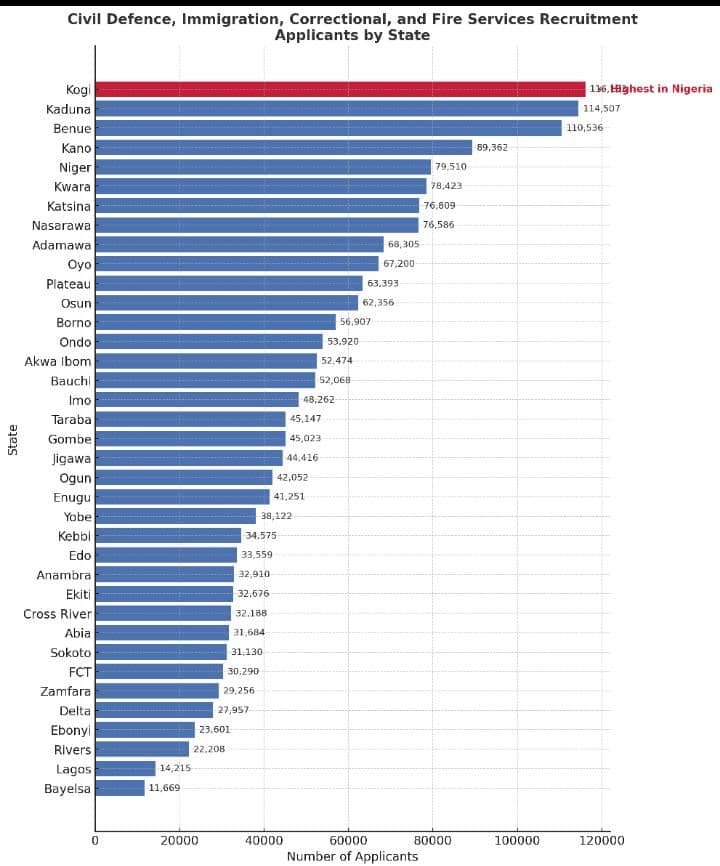
In the latest national recruitment exercise for the Civil Defence, Immigration, Correctional, and Fire Services, one figure towers above the rest: Kogi State recorded 116,133 applicants, the highest from any state in Nigeria. This is not merely a statistic. It is a stark symbol of a troubling reality, the Confluence State, once a proud centre of trade and culture, now wears the crown no state should covet: Nigeria’s unemployed king.
Think about the scale of this imbalance. Across the country, over 1.9 million Nigerians threw their hats into the ring for just 30,000 government jobs. That’s 63 contenders fighting for every single vacancy. But in Kogi, the numbers swell beyond proportion. With a population hovering just above four million, one out of every 35 residents applied for these positions, an astonishing concentration of desperation.
What does this say about the state of Kogi’s economy? The unvarnished truth is that the private sector here is underdeveloped, and the industrial landscape is more mirage than reality. A state rich in mineral deposits, strategically located at the heart of Nigeria, and blessed with an industrious population should be exporting value, not exporting CVs to federal ministries. Yet year after year, the same pattern repeats: young men and women, armed with degrees, diplomas, and dreams, queue up in droves for the slimmest of chances at government employment.
The lure of a government job is not mysterious. In a state where local industries are either moribund or non-existent, where salaries in the private sector are erratic at best and exploitative at worst, the idea of a steady paycheck, pension, and a measure of job security becomes irresistible. But herein lies the paradox: when everyone wants a government job, it means no one trusts the market to deliver prosperity. And without trust in the market, no real economy can grow.
Kogi’s unemployment crisis is not an accident; it is the result of years of economic drift and unimaginative policy. Successive governments have spoken the language of industrialisation but have done little to translate words into factories, supply chains, and jobs. Agriculture, which could be the state’s largest employer and wealth creator, remains shackled by poor infrastructure, minimal mechanisation, and the absence of large-scale processing plants. The state’s mineral wealth, from iron ore in Itakpe to coal in Okaba, is still largely trapped underground, waiting for investment that never comes.
This is not just an economic problem, it is a social time bomb. Large pools of unemployed youth are fertile ground for frustration, crime, and social unrest. When ambition has no outlet, it turns inward, curdling into disillusionment. Kogi risks producing a generation that sees its brightest path not in building enterprises, innovating, or producing, but in waiting, sometimes for years, for a slot in the civil service.
The uncomfortable truth is that Kogi cannot job-apply its way out of this crisis. The state needs a radical shift in strategy: a deliberate courting of private investors, the creation of industrial clusters around its natural resources, and a revival of its agricultural value chains with modern technology. Roads must connect farms to markets, not just towns to political rallies. The energy sector must move beyond diesel generators to sustainable, scalable power solutions that can keep factories humming. And the education system must pivot from producing white-collar hopefuls to producing problem-solvers, builders, and innovators.
Kogi has all the raw ingredients to turn the tide, strategic location, natural resources, and a willing workforce. But until the state moves from rhetoric to results, from dependency to dynamism, the queues for federal recruitment will only grow longer, and the crown of “Nigeria’s Unemployed King” will remain firmly on its head.
The tragedy is that this is not a crown of gold but of lead, a burden that drags down growth, ambition, and hope. The question is whether Kogi’s leaders have the vision and courage to cast it off before it becomes permanent.