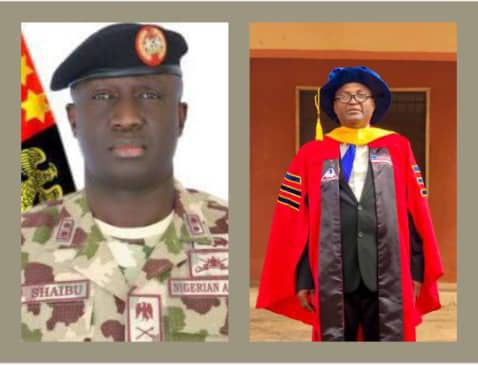
By Amb Valentine Opaluwa Ejeh, PhD
Abstract
To begin with since his appointment as Chief of Army Staff (COAS) of the Nigerian Army, Lieutenant General Waidi Shaibu has introduced a series of strategic reforms that have strengthened military effectiveness, enhanced institutional professionalism, deepened inter-agency cooperation, and expanded Nigeria’s defense partnerships — including with the United States and other international allies. This article assesses his leadership, drawing on policy speeches, strategic doctrinal shifts, operational adjustments, and evidence of sustained collaboration at national and international levels. It argues that General Shaibu’s leadership represents a vital evolution in Nigeria’s security architecture, navigating complex asymmetrical threats through integrated, intelligence-led, and multi-domain strategies.
1. Introduction: Leadership in a Complex Security Environment
The appointment of Lieutenant General Waidi Shaibu as Chief of Army Staff marked a strategic inflection point for the Nigerian Army. At a time when Nigeria faces a constellation of security threats — including insurgency, banditry, communal conflicts, and emerging cyber threats — effective leadership requires not only kinetic responses but also institutional reform, inter-agency synergy, and international cooperation. General Shaibu’s tenure demonstrates a deliberate pivot toward modern defence management aligned with global best practices.
2. Institutional and Doctrinal Reforms
2.1. Intelligence-Driven and Multi-Domain Strategy
In early 2026, Lt. Gen. Shaibu articulated a comprehensive intelligence-led, multi-domain strategy designed to address asymmetric threats that include terrorism, banditry, cybercrime, and organised crime. This approach underscores the integration of state and non-state security apparatuses, intelligence fusion, and technological leverage to enhance operational outcomes.
PRNigeria News +1
His emphasis on adapting Nigeria’s Army doctrine to evolving security dynamics reflects a shift from traditional force posture to proactive, integrated security frameworks, a hallmark of contemporary military leadership.
2.2. Technology, Training, and Capacity Strengthening
General Shaibu has actively endorsed the deployment of modern technologies and advanced platforms to improve operational effectiveness. The adoption of unmanned aerial systems, enhanced surveillance capabilities, and technology-enabled reconnaissance signifies a deliberate investment in knowledge-centric warfare against decentralised threats.
The Nation Newspaper
Moreover, his engagements with the Nigerian Defence Academy (NDA) to emphasise leadership training, research, and innovation point to a long-term institutional strengthening agenda that prioritises human capital development in defence.
Arise News
3. Operational Gains and Security Impact
3.1. Tactical Operations and Civil-Military Initiatives
Though comprehensive data on operational outcomes under his tenure are subject to continued reporting, evidence from credible sources indicates continued offensive and stabilisation operations across Nigeria’s conflict zones. These operations reflect the Nigerian Army’s sustained commitment to degrading terrorist and bandit networks and increasing civilian protection — aligning tactical operations with the broader strategic vision for national security.
His advocacy for a blend of kinetic and non-kinetic operations — where military action is paired with civil-military cooperation — reflects a nuanced appreciation that security also entails winning hearts and minds and restoring community trust.
The Eagle Online
4. Inter-Agency Cooperation and Civil-Military Relations
4.1. National Inter-Agency Integration
General Shaibu’s reforms prioritise synergy with Nigeria’s broader security framework, notably through systemic coordination with agencies such as the Department of State Services (DSS), Nigeria Immigration Service, and state security apparatus. This reflects an understanding that 21st-century threats cannot be defeated by a single actor, requiring a whole-of-government approach.
Storybasic
His public statements emphasise that enduring peace cannot be achieved by arms alone but must be complemented by effective governance, justice delivery, and socio-economic inclusion — principles at the heart of contemporary counter-insurgency theory.
PRNigeria News
5. International Cooperation: Nigeria–US Military Engagement
A defining aspect of General Shaibu’s tenure has been his intentional cultivation and reinforcement of Nigeria’s defence cooperation with the United States Armed Forces. In January 2026, he hosted the US defence attaché in Abuja, where discussions focused on deeper collaboration in doctrine development, capacity building, strategic planning, intelligence sharing, and welfare initiatives.
TheCable
The US–Nigeria military relationship has historically contributed to professionalising Nigerian forces, particularly through training, joint exercises, and institutional exposure to advanced operational doctrines. Under General Shaibu, this cooperation has been reaffirmed as mutually beneficial, reflecting shared interests in counter-terrorism, maritime security, humanitarian assistance, and peacekeeping readiness.
TheCable
This cooperative relationship strengthens not just tactical capacities but institutional frameworks — applying lessons from allied forces to upgrade Nigerian Army operational standards and ethical conduct.
6. Civil-Military Communication and Strategic Narratives
In recognition of the role of communication in shaping security environments, General Shaibu has championed strategic engagement with media and civil stakeholders. This approach enhances public understanding of military operations, promotes transparency, and counters misinformation that can exacerbate insecurity.
Voice of Nigeria Broadcasting Service
Such efforts align with best practices in modern defence policy, where information operations are integrated into broader security frameworks to sustain public confidence and reduce social dissonance.
7. Conclusion: Leadership Impact and Future Trajectory
Lieutenant General Waidi Shaibu’s tenure as Chief of Army Staff demonstrates strategic foresight, professional stewardship, and adaptive reform in the face of Nigeria’s multi-faceted security challenges. His leadership embodies a shift from reactive response towards anticipatory, integrated, and cooperative security governance.
The reforms and strategies championed under his command — intelligence-driven operations, inter-agency collaboration, institutional capacity building, and robust international partnerships — provide a foundation for sustained stability and professional modernisation of Nigeria’s Army.
As Nigeria continues to confront complex asymmetric threats, the direction set by General Shaibu offers a viable roadmap for security consolidation. His emphasis on collaboration, innovation, and civil-military synergy is both pragmatic and necessary for the evolving security landscape, and deserves scholarly recognition and policy support.
Amb Valentine Opaluwa Ejeh, PhD is a Peace & Conflict Scholar & Executive Director
ANU Community Peacebuilding & Environmental Sustainability Initiative (ACPESI)
Abuja, Nigeria
References
Nigerian Army Unveils Intelligence-Led Strategy to Combat Terrorism, Banditry, and Cybercrime — PRNigeria (February 3, 2026).
PRNigeria News
COAS Announces Multi-Domain Strategy to Combat Insecurity — The Nation (February 3, 2026).
The Nation Newspaper
COAS Assures of Kinetic and Non-Kinetic Operations — The Eagle Online (December 25, 2025).
The Eagle Online
Army Deploying Resources, Leveraging Technology — Gazette Nigeria (January 6, 2026).
Peoples Gazette Nigeria
Army Chief Seeks Stronger Nigeria-US Military Collaboration — TheCable (January 15, 2026).
TheCable
COAS Hails Chief Clerks in Era of Digital Transformation — PRNigeria (November 18, 2025).
PRNigeria News
Army Chief Promotes Enhanced Indigenous Capacity and Innovation — Arise News (November 28, 2025).
Arise News
How the COAS Conference Reassessed the Army’s Fight Against Terrorism — THISDAY LIVE (2025).
thisdaylive.com